
A 48-hour scramble and a planned exposure-reduction strategy in two data centers turn to remote switching solutions.
Personal protective equipment (PPE) is the last line of defense against arc flash, not a plan. The real work of electrical safety happens earlier: in engineering controls, in planning, in decisions made before anyone stands in front of energized switchgear. Two recent projects, run by two different commissioning teams in two different data centers, illustrate what that process looks like. Both used the Chicken Switch Hitter to get the job done.
The 48-Hour Scramble
Every commissioning schedule has a moment where the plan meets the field, and the field wins. For ColoShield, that moment came during prep for initial energization of critical switchgear at a data center project when the team realized they needed additional remote switching capability. And they needed it now.
The energization schedule was fixed, and the risk of operating switchgear without adequate remote capability wasn’t one anyone was willing to accept just to hit a date.
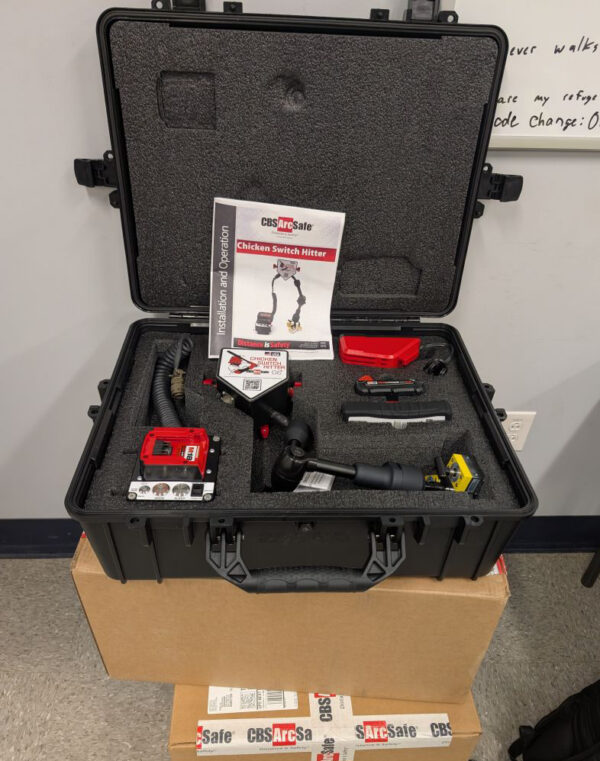
Within 48 hours, the ColoShield team sourced and received a Chicken Switch Hitter to the site. The solution let the project team maintain its energization schedule while keeping personnel at a safe working distance during switching operations. No delay and no compromise on safety.
Commissioning isn’t just testing systems and checking boxes. It’s identifying risk before it becomes a delay and having the equipment and the relationships in place to move fast to complete the project.

Planned From the Start
Not every use case starts with a scramble. At the Iron Mountain Data Center in Miami, Hypower built remote breaker operation into its energization plan from the outset, using the Chicken Switch Hitter to increase working distance and reduce personnel exposure during switching operations.
It’s the kind of setup that draws attention for good reason — clean, deliberate, and safely outside the arc flash hazard boundary. Hypower’s team noted that remote operation equipment has become a valuable tool for reducing personnel exposure during energization activities and supporting their NFPA 70E safety objectives.
In mission-critical facilities where energization activity is frequent and tightly controlled, that kind of planning is becoming less of an option and more of an expectation.
Two Projects, One Principle
Whether it’s an urgent need or a control built into the plan from day one, the underlying logic is the same: Reduce exposure before PPE ever has to do the job. The Chicken Switch Hitter keeps people outside the arc flash boundary during some of the highest-risk moments of a project — energization, initial testing, breaker operation on live gear — without slowing down the schedule.
That’s the shift happening across mission-critical construction and commissioning right now. The industry is moving past minimum compliance and toward eliminating exposure wherever possible. Remote switching makes that shift practical, not just theoretical.
Remote operations give your team working distance for electrical safety without adding time to the schedule. Whether you’re creating a day one safety plan or need solutions fast to keep a project moving, CBS ArcSafe can help. Contact us today.