
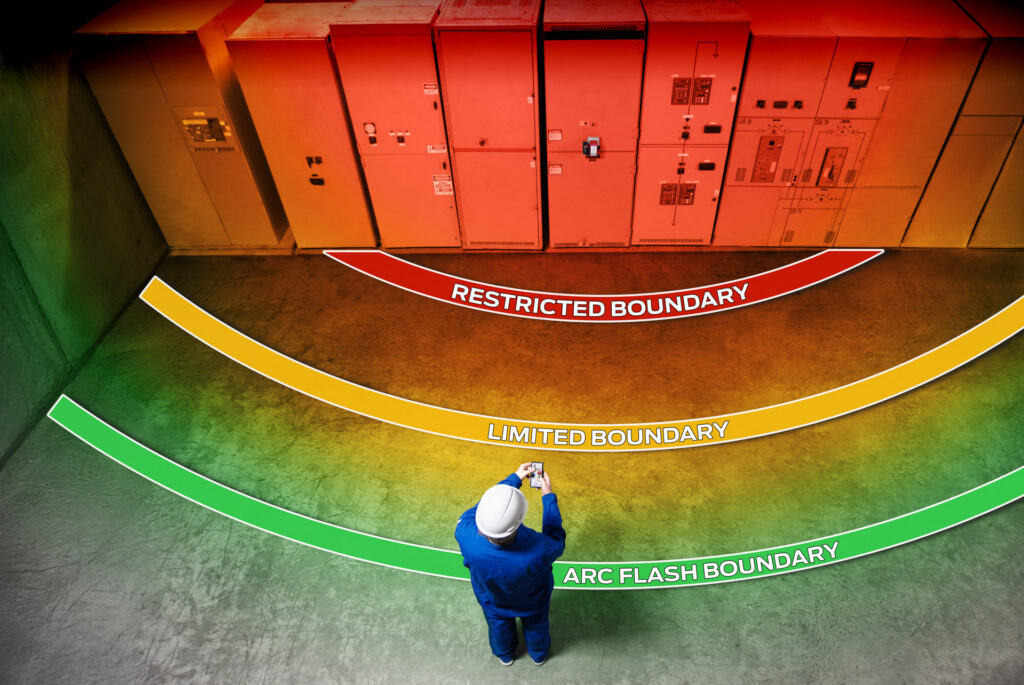
Revisions to the 2026 edition of the NEC share a common thread around worker safety: distance from energized equipment increases safety.
The benefits of following the National Electrical Code (NEC) are familiar to anyone who has stood in front of a switchgear lineup.
The 2026 edition of the NEC added hundreds of changes, and while most coverage applies to residential installations, the revisions share a common thread around worker safety: distance from energized equipment increases safety.
Three Changes Highlight Distance is Safety
Section 110.26, Spaces About Electrical Equipment, tightened its working space and egress language. The revision notes that access or egress is impeded when the space is less than 24 inches wide and 6½ feet high with equipment doors open at 90 degrees. The practical implication is that safe clearance needs to hold under real conditions, not just on a drawing with every door closed.
Section 230.62, Service Equipment — Enclosed or Guarded, and Barrier Placement, dictates that barriers must now be positioned so that energized terminals and bus work cannot be contacted inadvertently, which in practice means the line side of the service equipment. The rationale is that service conductors generally have no overcurrent protection downstream of the utility transformer, so a fault at those terminals can release considerably more energy than a comparable fault further into the system. Where distance is not available, the code calls for a physical barrier instead.
Section 625.43 now requires an emergency shut-off for electric vehicle supply equipment and wireless power transfer equipment in locations other than one- and two-family dwellings. That shut-off must be sited between 20 and 25 feet from the charging equipment — close enough to be found and operated, but far enough that a first responder can cut power without approaching a fire. When the NEC had the opportunity to specify a safe standoff distance, it specified one.
Three unrelated articles, three different hazards. In each case the answer is distance — either as enough space to stay clear, or as a barrier in cases where the space does not exist.
From the Installation to the Operation
The 2026 NEC edition also expanded Section 110.16, Arc-Flash Hazard Marking, so more equipment now carries more complete hazard information. Read this recap to learn how better labeling tells a worker what they are facing. What it doesn’t do is change the fact that they’re facing it.
This is where the hierarchy of controls comes in. The most effective protections remove the person from the hazard rather than harden the person against it. Distance applies just as well to the task as to the installation. Remote switching and remote racking let an operator perform potentially dangerous operations from outside the arc flash boundary, so the exposure is not reduced but avoided.
Whether your jurisdiction has adopted the new NEC edition yet or not, the direction is clear enough to plan around.
If you need a compliance partner, contact us to discuss your safety plan.